
In civil construction, maritime logistics, oil and gas refining, and heavy manufacturing, mechanical lifting operations represent some of the highest-risk activities conducted on a job site. Every day, thousands of tons of structural steel, concrete modules, and heavy plant machinery are suspended in mid-air above workforce personnel and critical infrastructure. When a crane failure, rigging snap, or structural collapse occurs, the results are almost universally catastrophic—leading to tragic loss of life, massive financial liabilities, and immediate project shutdowns.
Preventing these incidents requires far more than routine maintenance or casual visual checks by site foremen. It demands the rigorous, independent evaluation of a Certified Lifting Inspector. Across major international industrial hubs, including giga-project developments in Saudi Arabia and high-rise infrastructure expansions in the UAE, regulatory authorities and prime contractors now mandate that all lifting gear, cranes, and rigged assemblies undergo third-party inspection by certified personnel before being cleared for operation.
At PEEB Certification, we provide internationally benchmarked evaluation schemes that validate technical inspectors against global standards. Working in tandem with strategic safety leaders holding the Certified Safety Specialist credential, accredited lifting inspectors form the primary line of defense against mechanical failure in high-risk environments.
What You Will Learn
-
The fundamental mechanical and structural risks associated with heavy lifting operations on modern construction sites.
-
The primary inspection protocols required for mobile cranes, tower cranes, wire ropes, and below-the-hook rigging tackle.
-
Why international regulations demand independent third-party certification under ISO 17024 guidelines.
-
Answers to essential questions regarding inspector qualification, load testing, and recertification cycles.
-
How combining technical inspection credentials with system auditing designations like ISO 45001 Lead Auditor elevates your career status.
The Physics and Hazards of Mechanical Lifting
Heavy lifting gear is subject to extreme mechanical stresses, material fatigue, and environmental degradation. Factors such as dynamic loading, wind resistance, shock loads, and chemical exposure can rapidly compromise structural integrity that appeared sound just weeks prior.
Common root causes of lifting-related accidents include:
-
Rigging Hardware Degradation: Wire rope core failure, heat-damaged synthetic slings, worn shackle pins, and unlatched hooks.
-
Overloading and Incorrect Load Radii: Exceeding rated capacity limits due to inaccurate load weight estimation or improper boom angle calculations.
-
Outrigger and Soil Instability: Setting up mobile cranes on soft soil or unverified underground voids without task-appropriate outrigger pads.
-
Lack of Inspection Integrity: Operating equipment with expired thorough examination certificates or unverified repairs.
A qualified inspector understands the engineering dynamics behind these hazards, analyzing stress points and fatigue indicators that uncertified personnel overlook.
Core Inspection Domains for Heavy Lifting Gear
Thorough equipment examination encompasses both physical gear and the mechanical/hydraulic systems operating heavy plant machinery.
Below-the-Hook Lifting Tackle
Rigging gear—including alloy steel chain slings, synthetic web slings, wire rope assemblies, shackles, turnbuckles, and lifting beams—must be inspected before every shift and subjected to periodic thorough examinations. A Certified Lifting Inspector evaluates wear tolerances, stretching, corrosion, heat damage, and leg angle stress multipliers.
Mobile and Tower Cranes
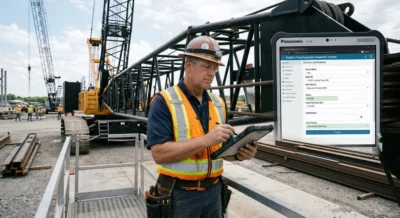
Crane inspections cover structural components, hydraulic systems, braking mechanisms, limit switches, anti-two-block devices, and load moment indicators (LMI). Inspectors verify that safety devices function within exact manufacturer tolerances and that load charts are accurately displayed.
Overhead Traveling Cranes and Hoists
In manufacturing facilities and workshops, bridge cranes and electric hoists require structural runway audits, wire rope reeving evaluations, end-stop testing, and electrical control checks to prevent unexpected load drops.
Regulatory Mandates and Third-Party Verification
International standards—including LOLER (Lifting Operations and Lifting Equipment Regulations), ASME/ANSI standards, and regional municipal codes—require that lifting equipment undergoes periodic thorough examination by a “competent person.”
However, in 2026, the definition of a competent person has tightened significantly. Employers can no longer rely on internal self-declarations. Major insurance underwriters and regulatory authorities demand that inspectors hold formal, accredited certification issued under ISO/IEC 17024 guidelines.
Holding a credential from the PEEB Certified Lifting Inspector program provides written, third-party proof that an inspector possesses verified expertise across metallurgy, non-destructive testing (NDT) interpretation, load testing protocols, and international regulatory compliance.
Questions & Answers
What is the difference between a daily user check and a thorough lifting inspection?
A daily user check is a visual pre-shift check conducted by the operator to identify obvious defects like cut slings or oil leaks. A thorough inspection is a comprehensive structural, mechanical, and functional evaluation performed periodically by an independent Certified Lifting Inspector using specialized measurement tools and NDT methods.
How often must heavy lifting equipment undergo certified inspection?
While daily checks are continuous, formal thorough examinations are typically mandated every 6 months for equipment used to lift persons (such as man-baskets) and every 12 months for general material lifting equipment, unless operating under severe environmental conditions that dictate shorter intervals.
How do site managers verify that an inspector’s certificate is authentic?
Clients and main contractors can enter the inspector’s registration details directly into the official PEEB verify certificate portal to instantly confirm their active status, authorized inspection scope, and certification expiration date.
Building a Multi-Disciplinary HSE Profile
High-risk industrial project sites require a balanced combination of strategic safety managers and specialized technical inspectors. Professionals who combine both skill sets position themselves at the absolute top of the industry salary bands.
To build a multi-disciplinary career path:
-
Master Technical Operations: Validate your specialized equipment knowledge through the Certified Lifting Inspector pathway.
-
Develop System Governance: Earn the Certified Safety Specialist credential to oversee overarching risk assessment, legal compliance, and site safety management systems.
-
Master Quality & Safety Auditing: Expand your governance authority by qualifying as an ISO 45001 Lead Auditor for health and safety or an ISO 9001 Lead Auditor for quality management systems.
Conclusion: Securing Operational Excellence
Heavy equipment and lifting operations leave zero margin for error. A single overlooked crack in a crane hook or an uncalibrated safety limit switch can lead to catastrophic consequences. By insisting on accredited, third-party inspection standards, organizations protect their workforce, safeguard expensive plant assets, and ensure uninterrupted project schedules.
Take the next step in your professional development. Explore our complete range of technical and managerial qualifications on PEEB’s certifications page. Learn more about our global accreditation standards on our About Us page, browse common queries on our FAQs section, or contact our admissions advisors through our Contact Us portal to elevate your professional credentials today.