
When navigating the complex landscape of workplace safety credentials, few terms generate as much confusion—and misrepresentation—as the phrase “occupational safety and health administration certification.” Across the global construction, manufacturing, and industrial sectors, job postings frequently demand “OSHA certified” safety officers, and thousands of professionals spend significant capital pursuing these credentials in hopes of securing leadership roles.
However, there is a fundamental misunderstanding embedded in this demand: the Occupational Safety and Health Administration (OSHA) is a regulatory government agency, not a personnel credentialing body. OSHA does not issue formal certifications to individuals in the way that independent, ISO 17024-accredited boards do. What is commonly referred to as “OSHA certification” is, in reality, a certificate of completion for voluntary outreach training programs (such as the OSHA 10-hour or 30-hour courses).
While these training courses provide an excellent baseline for general worker safety and regulatory awareness, treating them as proof of professional competence for a senior HSE role presents a massive liability for employers. In 2026, as major industrial operators across the GCC and beyond tighten their risk governance frameworks, executive leadership is drawing a sharp line between attending a training course and holding an independently evaluated, globally recognized credential like the Certified Safety Specialist.
What You Will Learn
-
The critical legal and structural differences between OSHA outreach training and true personnel certification.
-
Why the term “occupational safety and health administration certification” is technically inaccurate but widely used in the industry.
-
How independent ISO/IEC 17024 evaluation protects employers from liability and proves genuine technical competence.
-
Common questions regarding regulatory training requirements versus professional career advancement.
-
How to transition from basic attendance certificates to elite, globally accredited safety leadership status.
The Reality of OSHA Outreach Training
To understand the value of different safety credentials, we must clearly define their purpose. The OSHA Outreach Training Program is designed to promote fundamental worker safety and health. It provides workers with basic knowledge regarding the recognition, avoidance, abatement, and prevention of safety and health hazards in workplaces.
When an individual completes an OSHA 30-hour course, they receive a wallet card demonstrating that they sat through the required instructional hours. This is an incredibly valuable initiative for frontline workers, foremen, and junior supervisors, as it ensures a baseline understanding of regulatory rights and standard hazard controls.
However, attendance is not synonymous with mastery. The completion card does not verify that the individual has the strategic capability to design a comprehensive safety management system, conduct complex root-cause incident investigations, or align corporate operations with international standards like ISO 45001. When a company hires an HSE Manager or a Lead Auditor based solely on an OSHA training card, they are effectively placing enterprise-level risk management in the hands of someone whose competence has never been independently tested.
The ISO 17024 Standard: Independent Validation of Competence
This is where the distinction between training and certification becomes paramount. A true personnel certification, governed by the international ISO/IEC 17024 standard, operates on the principle of impartial evaluation.
Organizations like the Professional Excellence Evaluation Board (PEEB) do not sell mandatory training courses as a prerequisite for certification, completely removing the conflict of interest inherent in the “pay-to-pass” training industry. Instead, PEEB focuses exclusively on the independent assessment of a candidate’s existing knowledge, experience, and analytical capability.
When a professional earns the Certified Safety Specialist designation, they have successfully navigated a rigorous, psychometrically validated examination process. This credential proves to employers, regulatory bodies, and international clients that the individual possesses verified mastery over advanced safety engineering, financial risk management, and legal compliance. It elevates the professional from a passive attendee of a training seminar to a formally audited expert.
Protecting Enterprise Liability on High-Risk Sites
For multinational corporations, particularly those executing high-stakes giga-projects in regions like Saudi Arabia and the United Arab Emirates, the distinction between training and certification carries massive legal implications.
In the event of a catastrophic site incident resulting in severe injury or fatality, regulatory bodies and legal entities will immediately scrutinize the competence of the site’s safety leadership. If the organization’s defense relies on the fact that their safety manager held a basic 30-hour training card, they are highly vulnerable to claims of corporate negligence.
Conversely, if the site operations were overseen by a fully accredited Certified Safety Specialist—supported by specialized experts like a Certified Lifting Inspector—the organization can demonstrate that they exercised the highest level of due diligence by employing independently verified professionals. This significantly mitigates corporate liability and demonstrates a genuine, structural commitment to uncompromising worker safety.
Frequently Asked Questions (Q&A)
If OSHA doesn’t certify individuals, why do job postings ask for “OSHA Certification”?
This is largely due to industry shorthand and a lack of understanding among generalist HR recruiters. When a job description asks for “occupational safety and health administration certification,” they usually mean they want a candidate who has completed the OSHA 30-hour training course. However, for senior roles, savvy hiring managers know they actually need candidates with accredited professional credentials, not just training cards.
Is my OSHA 30-hour card useless for career advancement?
Not at all. Your outreach training provides a crucial foundation of regulatory knowledge. It is an excellent starting point for your career. However, to break through to senior management, directorial roles, or international auditing positions, you must build upon that foundation by challenging independent, examination-based certification schemes.
How can I prove to an employer that my certification is legitimate and not just an attendance certificate?
The hallmark of a legitimate, ISO-aligned personnel certification is public, instantaneous traceability. Accredited bodies maintain secure, searchable databases. For example, any employer evaluating a PEEB-certified professional can instantly validate their active credential status through the official verify certificate portal, completely eliminating the risk of credential fraud.
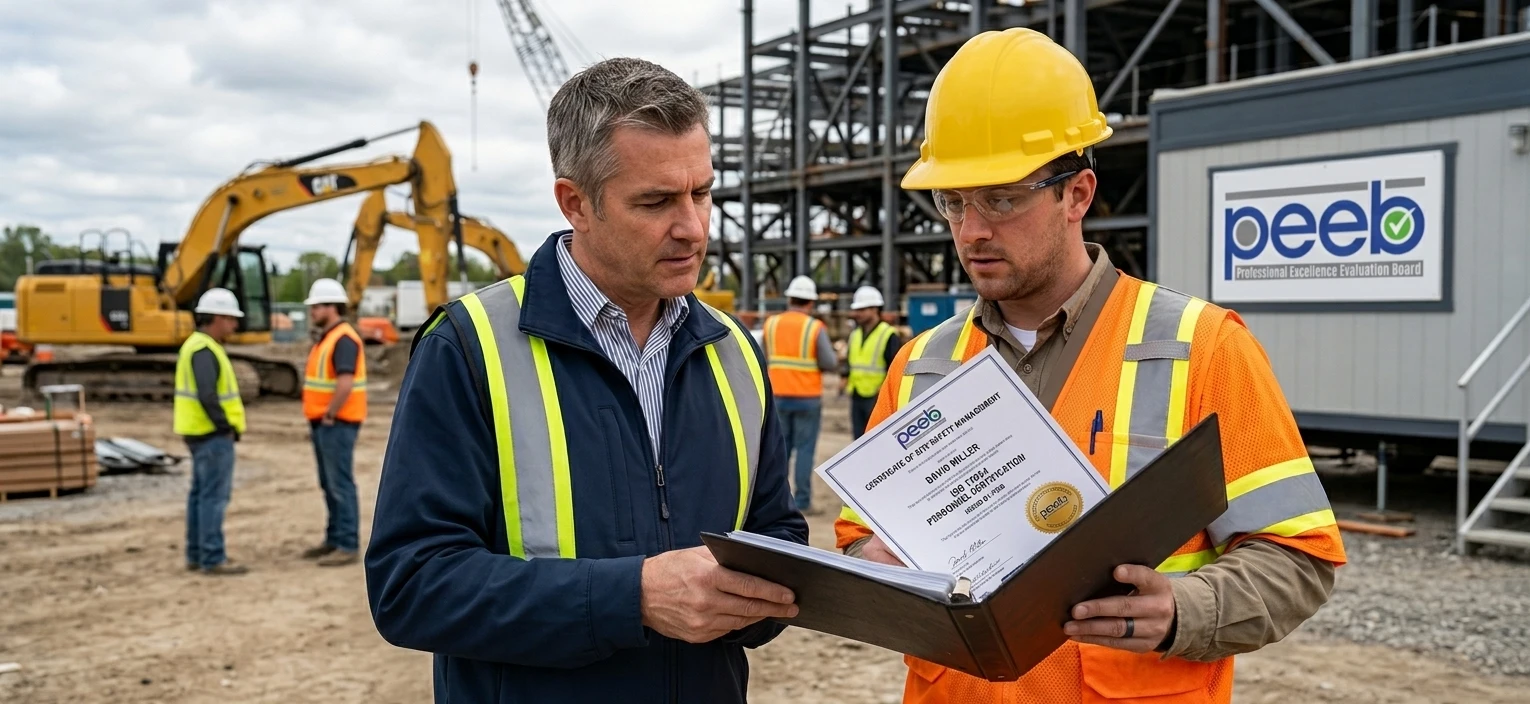
A project director verifying the accredited credentials of a site safety manager before operations begin.
Advancing Beyond Basic Training
The industrial sector is maturing rapidly, and the baseline requirements for professional success are rising in tandem. Relying on basic outreach training to carry you through a multi-decade career in occupational health and safety is no longer a viable strategy. Employers are demanding certainty, and certainty requires independent verification.
Whether you are looking to validate your broad strategic expertise or you wish to specialize deeply by pursuing an ISO 45001 Lead Auditor designation to manage comprehensive occupational health systems, your next step must involve formal, accredited evaluation.
Take control of your professional narrative. Move beyond the ambiguity of general training and secure a credential that speaks with absolute authority. Visit the PEEB certifications page today to evaluate the eligibility criteria, understand the examination frameworks, and take your definitive step toward becoming a globally recognized, independently verified leader in workplace health and safety.
