
The discipline of environmental health & safety (EHS) has undergone a radical transformation over the past decade. What once functioned as a strictly compliance-driven department—primarily concerned with avoiding regulatory fines and managing basic worker compensation claims—has evolved into a central pillar of global corporate strategy. Today, leading organizations across the Middle East, Europe, and North America recognize that robust EHS performance is inextricably linked to operational efficiency, brand reputation, and financial sustainability.
This evolution is largely driven by the global surge in Environmental, Social, and Governance (ESG) reporting requirements. Investors and stakeholders no longer accept baseline regulatory compliance as a benchmark for success. They demand proactive, transparent management of environmental impacts and a demonstrable commitment to workforce well-being. Consequently, the demand for highly competent professionals capable of navigating these intersecting disciplines has never been higher.
However, managing this complex matrix of responsibilities requires far more than generic industry experience. It demands the rigorous, verified expertise of a Certified Safety Specialist who can architect overarching risk management systems, alongside the specialized oversight of professionals credentialed under international frameworks like ISO 14001 and ISO 45001.
What You Will Learn
-
The strategic convergence of environmental management, occupational health, and workplace safety in modern enterprise.
-
How EHS performance directly impacts corporate ESG ratings and stakeholder investment.
-
The critical differences between legacy reactive safety programs and modern, predictive EHS management systems.
-
Commonly asked questions regarding EHS career advancement and system implementation.
-
How achieving independent, ISO-aligned personnel certification secures your position as a top-tier EHS leader.
The Three Pillars of Modern EHS Management
To understand the scope of modern environmental health & safety, one must break down the discipline into its core intersecting pillars. A failure in any one of these areas inevitably compromises the integrity of the entire organizational structure.
1. Environmental Stewardship and Sustainability
Industrial operations carry inherent risks to local ecosystems, ranging from chemical spills and hazardous waste disposal to localized air pollution and excessive resource consumption. Modern environmental management focuses on minimizing this footprint through sustainable operational design. Professionals in this space must navigate complex, region-specific environmental regulations, ensuring that industrial discharge meets strict legal thresholds. By implementing frameworks governed by standards such as ISO 14001, organizations can systematically reduce waste, lower energy consumption, and prove their commitment to environmental preservation.
2. Occupational Health and Industrial Hygiene
While safety often focuses on acute, immediate physical injuries, occupational health addresses the chronic, long-term well-being of the workforce. This includes managing exposure to airborne particulates, toxic chemicals, extreme noise levels, and severe temperature fluctuations—a particularly critical concern for construction and oil operations in the GCC region. Modern EHS leaders must conduct rigorous industrial hygiene assessments, implementing engineering controls that prevent long-term respiratory illnesses, hearing loss, and ergonomic degradation. Furthermore, this pillar has expanded significantly to encompass psychosocial hazards, requiring leaders to actively manage workplace stress and operational fatigue.
3. Workplace Safety and Incident Prevention
The traditional core of the discipline involves the direct prevention of workplace accidents, ranging from catastrophic machinery failures to routine slips and falls. This requires the continuous execution of job safety analyses, rigorous equipment inspections, and the maintenance of a deeply ingrained safety culture. Specialists verify that critical activities, such as heavy lifting, are overseen by validated experts like a Certified Lifting Inspector, ensuring that high-risk operations are executed without incident.
EHS as a Driver of Commercial Value and ESG Success
For many years, executive boards viewed EHS departments strictly as a cost center—a necessary financial drain required to keep the business out of legal trouble. That paradigm is entirely obsolete. Today, exceptional environmental health & safety performance is a distinct competitive advantage.
When an organization bids on major international infrastructure projects, such as those driving Saudi Arabia’s Vision 2030 or the UAE’s sustainability initiatives, their historical EHS data is heavily scrutinized during the vendor pre-qualification phase. Companies with high incident rates or a history of environmental negligence are systematically excluded from the bidding process, regardless of their pricing structures.
Furthermore, the integration of EHS into broader ESG reporting means that institutional investors are directly analyzing a company’s safety and environmental metrics before allocating capital. A verified EHS leader—particularly one holding systemic auditing credentials like the ISO 9001 Lead Auditor or the ISO 14001 Lead Auditor—provides the executive board with the precise data and structural assurance needed to satisfy these external stakeholders, thereby lowering the company’s cost of capital and securing high-value contracts.
Frequently Asked Questions (Q&A)
What is the most critical skill for a modern EHS manager?
The most vital skill is the ability to translate technical risk data into strategic business language. A modern EHS manager must be able to sit in a boardroom and clearly explain how an investment in a new hazard control system will positively impact production uptime, reduce insurance premiums, and satisfy upcoming regulatory changes.
How do I transition from a specialized safety role into a comprehensive EHS leadership position?
Moving from a localized safety officer role to a corporate EHS position requires broadening your systemic knowledge. You must move beyond simple compliance checking to mastering management systems architecture. Earning a comprehensive, internationally accredited credential like the Certified Safety Specialist validates to employers that you possess the multidisciplinary expertise required to oversee environmental, health, and safety risks simultaneously.
Why do companies prefer candidates with ISO 17024 personnel certification for EHS roles?
Because EHS leaders hold massive legal and financial responsibility for the company, executive boards cannot rely on attendance-based training certificates to prove a candidate’s competence. ISO 17024 personnel certification provides independent, third-party verification that the candidate has passed a rigorous evaluation of their actual operational capabilities, offering the employer a critical layer of liability protection.
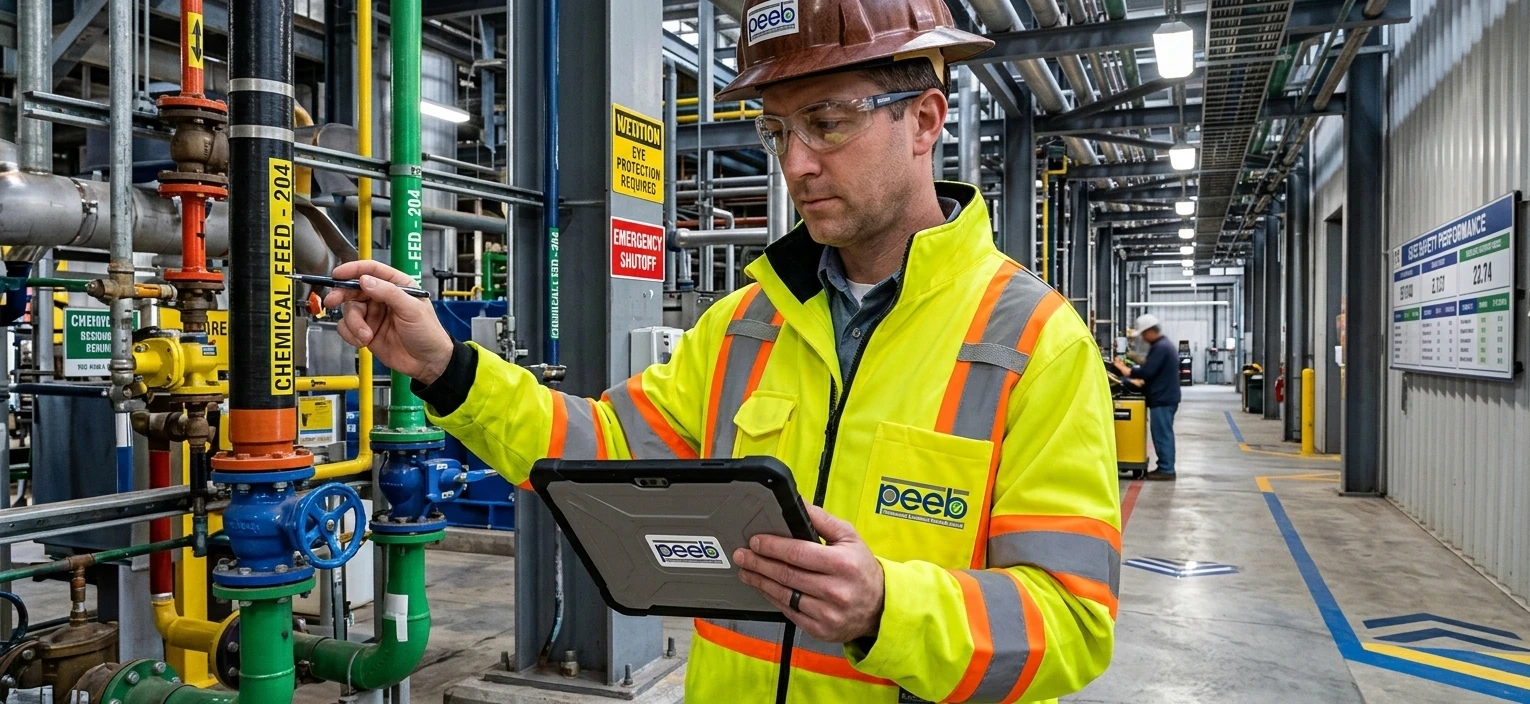
A Certified Safety Specialist conducting a comprehensive environmental and safety audit at an industrial facility.
Future-Proofing Your Career in EHS
The trajectory of the environmental health & safety profession is clear: increased complexity, tighter regulatory integration, and a permanent seat at the executive strategy table. Those who fail to adapt their skill sets to this new reality will find themselves relegated to low-level administrative roles, while proactive professionals who validate their expertise will command premium compensation and significant operational authority.
At PEEB Certification, we provide the independent evaluation framework necessary to prove your mastery of these complex domains. Whether you are seeking to validate your broad strategic capabilities or specialize as an ISO 45001 Lead Auditor to manage occupational health systems, our accredited pathways are designed for the modern industry leader.
You can explore our full range of qualifications on our certifications overview page. Once certified, your credentials will be permanently registered on our secure verify certificate portal, providing instantaneous proof of your elite status to employers worldwide. Do not wait for the industry to outpace your qualifications; elevate your professional standing today.
