

Across heavy construction, energy production, manufacturing, and logistics sectors in Saudi Arabia, the United Arab Emirates, and the wider Gulf Cooperation Council (GCC), organizations invest millions of dollars every year into occupational health and safety initiatives. Yet, despite thick compliance binders and regular site briefings, many enterprises still suffer from recurring near-misses, operational bottlenecks, and preventable workplace injuries. The root cause rarely stems from a lack of intention; rather, it comes from treating safety programs as static administrative documents instead of living, continuously verified operational systems.
An effective workplace safety program does not exist simply to pass an annual municipal inspection or satisfy a tender pre-qualification checklist. True safety programs integrate directly into daily work execution, empowering frontline crews to recognize hazards before harm occurs while giving executive leadership measurable data on enterprise risk exposure. Across high-stakes regional developments—from giga-project infrastructure in Riyadh and NEOM to industrial complexes in Abu Dhabi—prime contractors and government authorities increasingly demand that these programs be designed, managed, and audited by independently verified safety leaders.
At PEEB Certification, we evaluate safety professionals against rigorous international benchmarks so they can architect resilient, zero-harm operational frameworks. Whether you are leading site-wide hazard controls as a Certified Safety Specialist or verifying management system integrity as an ISO 45001 Lead Auditor, mastering the lifecycle of modern safety program design is essential for lasting operational excellence.
What You Will Learn
-
Why traditional, paper-heavy safety manuals fail on dynamic industrial job sites and how to replace them with active controls.
-
The five essential pillars required to design, launch, and sustain high-impact workplace safety programs.
-
How continuous internal and third-party auditing transforms compliance from a one-time event into ongoing risk reduction.
-
Clear answers to key questions regarding safety program metrics, worker participation, and contractor alignment.
-
Strategic ways to combine specialist and auditor credentials to lead enterprise-wide safety initiatives across the GCC.
Why Paper-Based Safety Manuals Fail on Active Job Sites
One of the most common pitfalls in industrial risk management is the disconnect between corporate policy writing and field-level reality. Many organizations purchase generic templates or copy legacy procedures that fail to reflect the specific environmental, mechanical, and human factors of their actual operations.
When safety programs are built in isolation from the workforce, three predictable failures emerge:
-
Procedural Fatigue: Frontline supervisors and workers become overwhelmed by overly complex permit forms and irrelevant checklists, leading to shortcuts during peak operational schedules.
-
Reactive Hazard Management: Without dynamic risk assessments tailored to changing site conditions—such as extreme summer heat in the Gulf, shifting crane radii, or simultaneous subcontractor activities—controls remain outdated.
-
Lack of Accountability: When roles and stop-work authorities are vaguely defined, safety enforcement breaks down the moment production deadlines tighten.
Modern safety programs eliminate these vulnerabilities by anchoring every policy in practical risk assessment, clear leadership accountability, and continuous verification.
The Five Pillars of High-Impact Workplace Safety Programs
Building a resilient safety program requires a structured architecture that aligns operational execution with international standards like ISO 45001.
1. Visible Leadership Commitment and Governance
No safety initiative survives without active backing from executive management. Leadership commitment goes beyond signing a policy statement; it requires allocating dedicated budgets for engineering controls, empowering every worker with unconditional Stop Work Authority (SWA), and holding project managers accountable for leading safety indicators alongside production targets.
2. Dynamic Hazard Identification and Risk Assessment
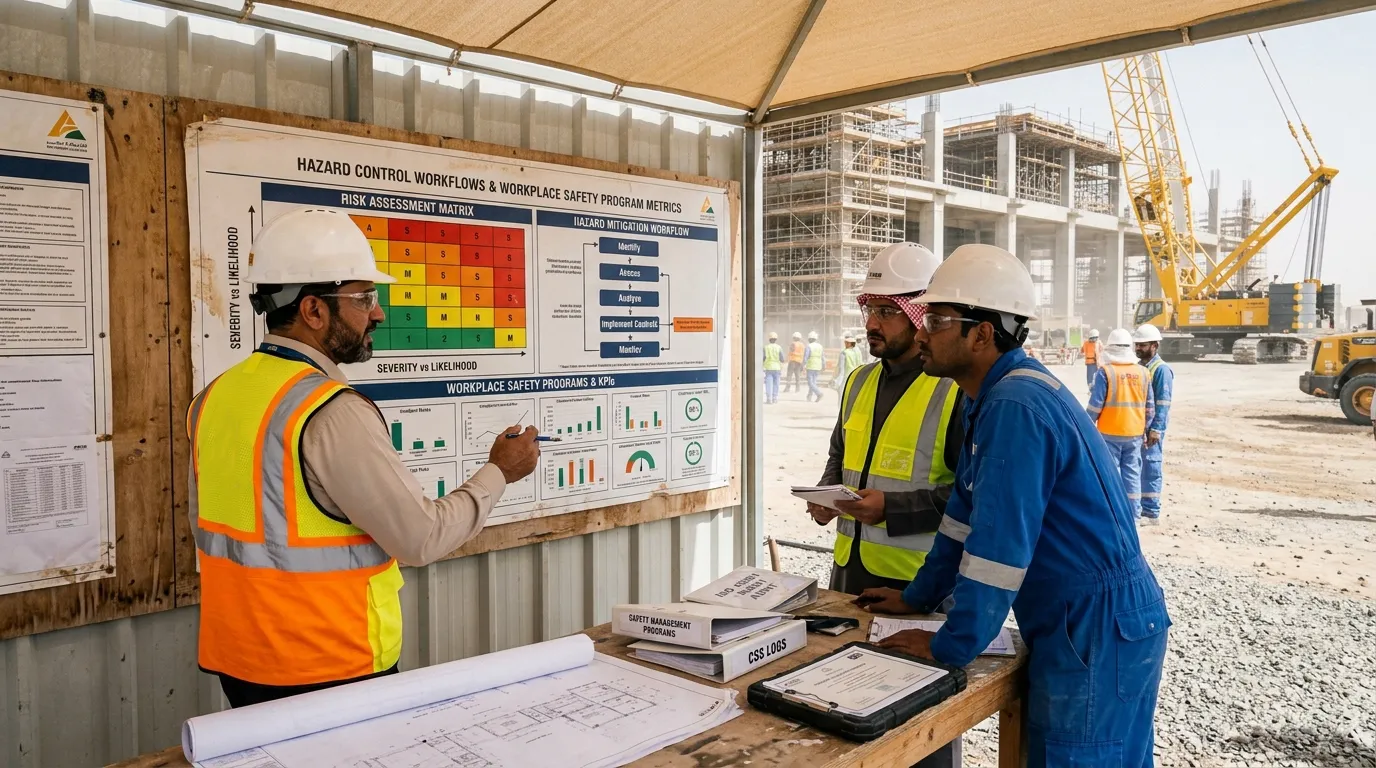
Effective safety programs rely on continuous, task-specific risk evaluation. Before high-risk operations commence, qualified leaders conduct thorough Job Safety Analyses (JSA) and Hazard Identification and Risk Assessments (HIRA), applying the Hierarchy of Controls—prioritizing hazard elimination, substitution, and engineering controls over administrative rules and personal protective equipment (PPE).
3. Specialized Technical Oversight for High-Risk Activities
General safety rules are insufficient for specialized industrial tasks. Activities such as confined space entry, lockout/tagout (LOTO) energy isolation, excavation, and heavy mechanical lifting require dedicated technical protocols. Ensuring that crane and rigging operations are overseen by an accredited Certified Lifting Inspector, for instance, embeds verified mechanical integrity directly into the site safety program.
4. Workforce Training, Consultation, and Engagement
A safety program only functions when the people executing the work understand and trust it. High-performing organizations involve frontline workers in developing procedures, run focused daily safety shares, maintain multilingual communication channels for diverse GCC workforces, and foster a psychological climate where near-misses are reported openly without fear of blame.
5. Continuous Monitoring and Independent Audit Verification
What gets measured gets managed. Modern safety programs track both lagging indicators (such as Lost Time Injury Frequency Rates) and leading indicators (such as completed hazard observations, preventive maintenance rates, and permit compliance). Crucially, these metrics are validated through scheduled internal and third-party audits led by an accredited ISO 45001 Lead Auditor.
Aligning Safety Programs with Enterprise Management Systems
On major industrial and infrastructure projects, workplace safety operates alongside strict quality and environmental mandates. Organizations that align their safety programs with broader management frameworks gain significant operational efficiency.
| Program Component | Core Operational Activity | International Benchmark | Validating Credential |
| Strategic Risk & Field Controls | Designing JSA/HIRA workflows, emergency plans, and site safety governance | ISO/IEC 17024 Personnel Standard | Certified Safety Specialist |
| OH&S System Auditing | Evaluating policy compliance, worker consultation, and corrective action loops | ISO 45001 | ISO 45001 Lead Auditor |
| Quality & Process Integration | Standardizing operational workflows, supplier controls, and documentation | ISO 9001 | ISO 9001 Lead Auditor |
| Environmental Risk Control | Managing hazardous waste, emissions, and site ecological protection | ISO 14001 | ISO 14001 Lead Auditor |
| Lifting & Equipment Integrity | Conducting thorough examinations of cranes, hoists, and rigging gear | LOLER / ASME / ISO | Certified Lifting Inspector |
Questions & Answers
How often should an organization review and update its workplace safety programs?
While formal management reviews should occur at least annually, safety programs must be treated as living frameworks. Any significant change in equipment, site layout, subcontractor scope, regulatory standards, or findings from a near-miss investigation should trigger an immediate review and update of the relevant procedures.
What are the most effective leading indicators to track in a safety program?
Leading indicators measure proactive actions that prevent incidents before they happen. Effective examples include the percentage of corrective actions closed on time, daily safety share participation rates, pre-operational equipment inspection completion, and the frequency of management safety walk-throughs.
How do clients and regulators verify the qualifications of the leaders managing our safety program?
Across Saudi Arabia, the UAE, and international markets, project owners require verifiable proof of personnel competence rather than self-declared resumes. Employers and pre-qualification teams can instantly verify active credential status and certified scopes through the official PEEB certificate verification portal.

Advancing Your Career by Mastering Safety Program Architecture
Professionals who can build, scale, and audit comprehensive safety programs are among the most sought-after leaders in the global HSE sector. Rather than remaining confined to routine site monitoring, mastering program architecture positions you for senior HSE Manager, Director, and Principal Consultant roles across high-growth markets.
To establish undeniable authority in safety program governance:
-
Validate Technical & Strategic Mastery: Earn the Certified Safety Specialist credential to prove your competence across risk assessment, safety engineering, industrial hygiene, and regulatory compliance.
-
Master Independent System Auditing: Qualify as an ISO 45001 Lead Auditor to lead enterprise-wide compliance audits and drive continuous system improvement.
-
Broaden Cross-Functional Governance: Pair your safety qualifications with ISO 9001 Lead Auditor and ISO 14001 Lead Auditor credentials to oversee fully integrated management systems.
Conclusion: Turn Safety Policy into Operational Reality
Effective safety programs do more than satisfy regulatory checklists—they protect human lives, prevent costly operational disruptions, and build lasting trust with clients, investors, and regulators. By anchoring your safety initiatives in dynamic risk assessment, active workforce engagement, and continuous audit verification, you create a resilient culture where zero-harm performance becomes the daily standard.
Ready to elevate your professional credentials and lead world-class safety initiatives? Explore our full suite of internationally accredited pathways on PEEB’s certifications page. Learn more about our ISO/IEC 17024 accreditation standards on our About Us page, browse candidate guidelines on our FAQs section, or connect with our admissions team via our Contact Us portal to take your next decisive step today.