
The Middle East is currently undergoing an unprecedented industrial and infrastructure metamorphosis. From the sprawling “Giga-projects” of Saudi Arabia’s Vision 2030 to the cutting-edge sustainable developments in the UAE, the demand for world-class safety leadership has never been more critical. However, for many practitioners in the region, the path to obtaining a high-tier safety professional certification is often blocked by rigid bureaucratic requirements, exorbitant international costs, or purely academic hurdles that ignore years of frontline experience.
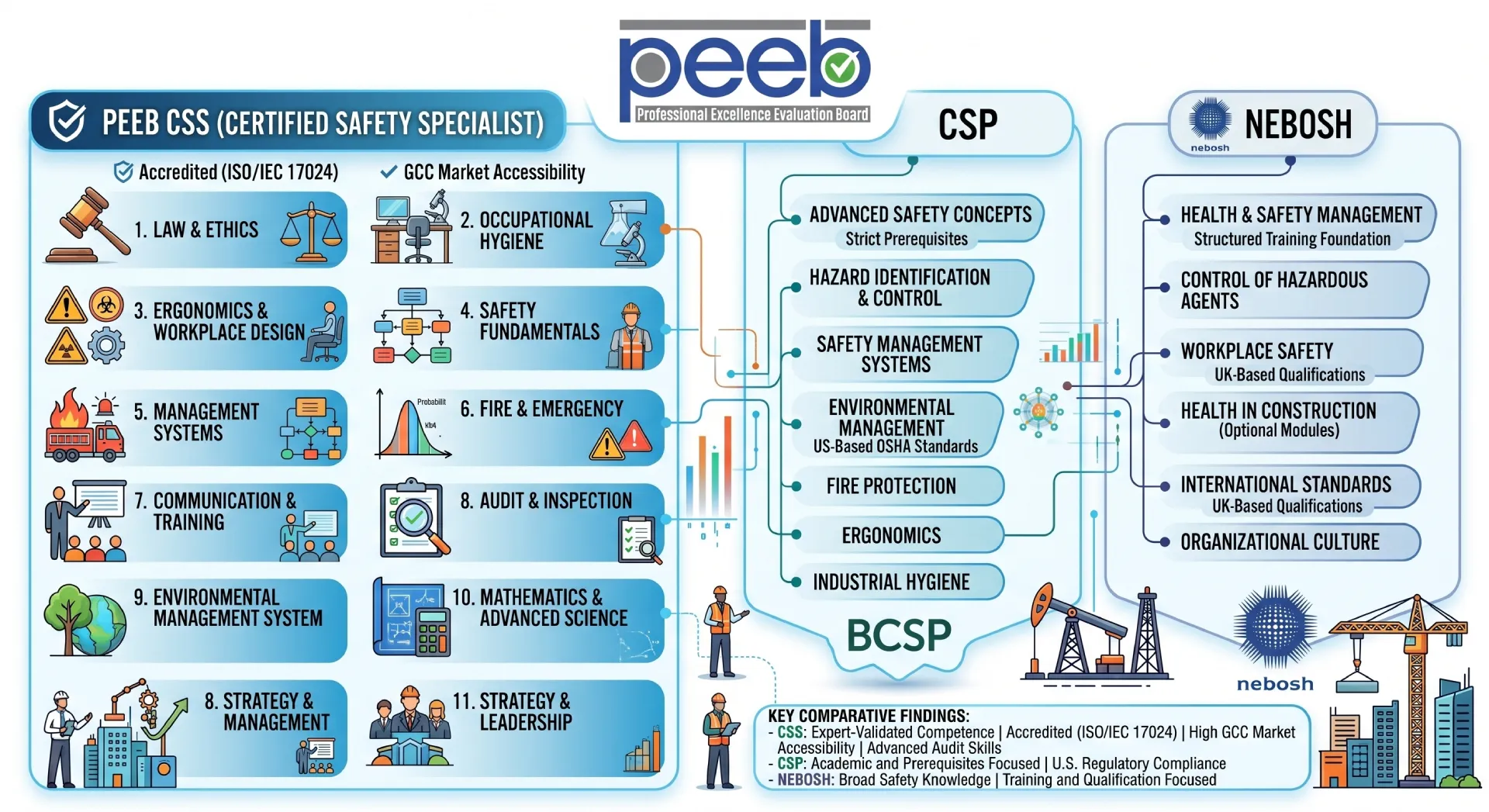
When comparing the global heavyweights like the CSP (Certified Safety Professional) and NEBOSH, professionals often find themselves caught between a rock and a hard place. The CSP, while prestigious, often requires a specific four-year U.S.-equivalent degree that many veteran expatriates in the Gulf do not hold. NEBOSH, while widely recognized, is primarily a training-based qualification rather than a formal ISO-accredited personnel certification. This is where the Certified Safety Specialist (CSS) by PEEB Certification has emerged as the definitive 2026 gold standard for residents in the KSA and UAE.
The CSS isn’t just another certificate; it is an IAS-accredited, ISO/IEC 17024:2012 compliant professional designation. It offers a streamlined, rigorous, and highly accessible pathway for those who already possess the skills but need the global validation to move into senior HSE leadership roles. In this guide, we will break down the certification landscape in the Middle East and explain why the Certified Safety Specialist is the smartest strategic move for your career this year.
What You’ll Learn
-
A direct comparison of CSP, NEBOSH, and the PEEB CSS within the Middle Eastern job market.
-
Why the Certified Safety Specialist is the most accessible ISO-accredited exam for KSA and UAE residents.
-
The role of IAS accreditation in ensuring your credential is recognized by government bodies and Tier-1 contractors.
-
How the CSS integrates with specialized roles like the ISO 45001 Lead Auditor and Certified Lifting Inspector.
-
Detailed eligibility pathways that honor both academic degrees and field-tested experience.
The Middle East Safety Landscape in 2026
The safety sector in the GCC (Gulf Cooperation Council) has matured significantly. No longer can a project manager simply “assign” safety duties to a junior staff member. Regulatory bodies such as the Saudi Council of Engineers and various UAE municipal authorities now require evidence of formal competency. This has created a “certification race,” where professionals are looking for the best ROI (Return on Investment).
Traditional paths like the CSP often require candidates to jump through hoops that are disconnected from the Middle Eastern reality. For example, the requirement for a Bachelor’s degree from a specific accredited list can be a dead-end for a highly skilled safety manager who holds a technical diploma and twenty years of experience in the oil fields of Abu Dhabi. Similarly, while NEBOSH provides excellent foundational knowledge, it is a “course-first” model. PEEB Certification’s Certified Safety Specialist program is “certification-only,” meaning it validates the expertise you already have through a rigorous assessment, making it faster and more cost-effective for true experts.
CSP vs. NEBOSH vs. PEEB CSS: The 2026 Comparison
To understand which credential will serve you best in the Middle East, we must look at accessibility, accreditation, and local market relevance.
The CSP (Certified Safety Professional)
The CSP is a high-level American credential. While it carries weight globally, its accessibility in the Middle East is limited. The application process is notoriously complex for non-U.S. residents, often requiring expensive third-party degree evaluations. Furthermore, the exam focuses heavily on North American regulations (OSHA), which, while similar to ISO standards, may not be 100% relevant to a professional working under the Saudi Labor Law or UAE Ministerial Decrees.
NEBOSH International Diploma
NEBOSH is the most common entry-level and mid-level qualification in the Gulf. However, it is important to distinguish between a qualification (which results from a training course) and a certification (which is an independent validation of competence). Many senior roles in 2026 now specifically ask for ISO 17024 accredited certifications to ensure the professional has met an international benchmark for personal competence.
The PEEB Certified Safety Specialist (CSS)
The Certified Safety Specialist is designed for the global professional. Because PEEB Certification is accredited by the International Accreditation Service (IAS), the CSS carries the same international weight as any Tier-1 credential. For a resident in the KSA or UAE, the CSS is the most accessible because:
-
It offers multiple eligibility pathways (including the Veteran Path for those without high-level degrees).
-
The exam is based on global ISO standards (like those found in ISO 9001 Lead Auditor and ISO 45001 Lead Auditor).
-
It can be completed via Computer-Based Testing (CBT) without the need for international travel or complex transcript evaluations.
Why Accessibility Matters for KSA and UAE Residents
In the high-speed environment of Middle Eastern development, time is your most valuable asset. If you are a Certified Lifting Inspector working on a project in NEOM, you don’t have six months to wait for a foreign board to evaluate your high school diploma from twenty years ago. You need a certification body that understands the international nature of the regional workforce.
The Certified Safety Specialist program by PEEB Certification was built with this flexibility in mind. By focusing on the 11 Technical Domains—which include Law & Ethics, Fire Management, and Advanced Risk Management—the CSS ensures that you are tested on the skills that actually keep workers safe on a site in Jeddah or Dubai. It is a practical, rigorous assessment that respects the professional’s time and existing knowledge base.
The Pillars of the CSS: A 2026 Perspective
To be a Certified Safety Specialist, you must prove excellence across a wide spectrum. This is not a “one-topic” certificate. It covers the holistic needs of a modern HSE Director.
1. Management Systems and ISO Alignment
A major component of the CSS involves understanding how safety integrates into broader management frameworks. This is why many CSS holders also pursue an ISO 14001 Lead Auditor certification to manage environmental impacts or an ISO 22000 Lead Auditor credential for food safety in the hospitality sector.
2. Mathematics and Engineering Science
The CSS requires technical proficiency. You will be tested on your ability to perform calculations related to load limits, chemical thresholds, and statistical risk. This technical edge is what differentiates a Certified Safety Specialist from a generalist.
3. Occupational Health and Industrial Hygiene
With the extreme temperatures and unique environmental challenges of the Middle East, industrial hygiene is paramount. The CSS covers the monitoring and control of physical, chemical, and biological hazards—a core requirement for any ISO 45001 Lead Auditor conducting a deep-dive audit.
4. Advanced Risk Management
Moving beyond simple checklists, a Certified Safety Specialist must be able to apply quantitative risk assessment techniques. This is essential for large-scale energy projects where the cost of failure is astronomical.
Eligibility Pathways: Breaking the Degree Barrier
One of the primary reasons PEEB’s Certified Safety Specialist has become the leading choice in the Middle East is its inclusive approach to eligibility. We recognize that education comes in many forms. According to the International Accreditation Service (IAS), the goal of ISO 17024 is to certify competence, not just academic history.
The Academic Route
If you have a Master’s or Bachelor’s degree (in any field), you only need two years of professional safety experience to apply for the CSS. This is perfect for engineers or business managers who have transitioned into HSE roles.
The Technical Diploma Route
For those with an Associate Diploma in HSE, the requirement is three years of experience. This acknowledges the specialized training provided by technical colleges across the Middle East.
The Veteran Route
This is the “accessibility champion.” If you have a high school diploma or a non-technical Associate degree but possess five years of verifiable safety experience, you are eligible to sit for the Certified Safety Specialist exam. This pathway ensures that the most experienced “boots on the ground” in the KSA and UAE can finally achieve the professional recognition they deserve.
The Strategic Advantage of Being “Dual-Certified”
In the competitive landscape of 2026, having one certification is often not enough. Employers are looking for professionals who can “wear multiple hats.” For example, a Certified Safety Specialist who also holds an ISO 27001 Lead Auditor credential is uniquely positioned to handle the safety of data centers—one of the fastest-growing sectors in the UAE.
Similarly, those working in manufacturing often combine their CSS with an ISO 9001 Lead Auditor certification to ensure that safety and quality management are treated as a single, unified process. By choosing PEEB for your lead auditor certification needs, you create a seamless professional portfolio that is easy for employers to verify.
How to Apply: A Step-by-Step for Regional Professionals
The process for becoming a Certified Safety Specialist is designed to be as efficient as a modern Middle Eastern infrastructure project.
-
Eligibility Pre-Check: Visit the Certified Safety Specialist page and determine which pathway (A, B, or C) matches your profile.
-
Document Submission: Upload your CV and certificates. Our board will verify your experience. Integrity is our priority, and we utilize a robust certificate verification system to protect the value of your credential.
-
Application Approval: Once approved, you are ready to book your exam.
-
The Exam: Sit for the CSS exam via Computer-Based Testing. The exam is practical and scenario-based, reflecting the real-world challenges you face in the Middle East.
-
Certification and Maintenance: Upon passing, you receive your IAS-accredited CSS designation. To keep it active, you simply participate in annual Continuing Professional Development (CPD), which can include earning further credentials like the ISO 14001 Lead Auditor.
The ROI of CSS in the Middle East Market
Why do employers in Riyadh and Dubai prefer the Certified Safety Specialist? It comes down to trust and transparency. PEEB Certification is an independent, third-party body. We do not sell training, which means our examinations are completely unbiased evaluations of a candidate’s skill.
Furthermore, the salary delta for a Certified Safety Specialist is significant. Recruiters in the region report that professionals with accredited safety certifications earn between 20% and 35% more than their uncertified counterparts. When you add specialized skills like being a Certified Lifting Inspector or a lead auditor in multiple ISO standards, that premium increases even further.
Conclusion: Securing Your Professional Legacy
The Middle East in 2026 is a land of opportunity for those who can prove their worth. The days of “paper certifications” are over; the era of the accredited specialist has arrived. By choosing to become a Certified Safety Specialist, you are not just passing an exam—you are future-proofing your career.
Whether you are looking to lead the safety team at a new solar farm in the Saudi desert or audit a multinational corporation’s systems as an ISO 45001 Lead Auditor, the CSS provides the foundational authority you need. It is the most accessible, globally recognized, and practical certification available for professionals in the KSA and UAE today.
Are you ready to take your place among the region’s HSE elite? Visit our blog for more industry insights or head straight to our certifications page to start your journey. The vision for a safer Middle East is being built right now—be the Certified Safety Specialist who leads it. Check your eligibility today and see how far your experience can take you.
